Ectopic Pregnancy Also Called: Extrauterine Pregnancy
First let me say . Hugs for you, and the stress you’re going through. I hope this information helps you arm yourself with the knowledge you need to find peace, no matter your outcome.
Good luck wishes for you and your little bean. Now, onto the information you were looking for.
Table Of Contents
What is an Ectopic Pregnancy?
For a pregnancy to be successful, many things need to happen.
One of the first is the fertilized egg needs to implant in the right place - the inner lining of the uterus.
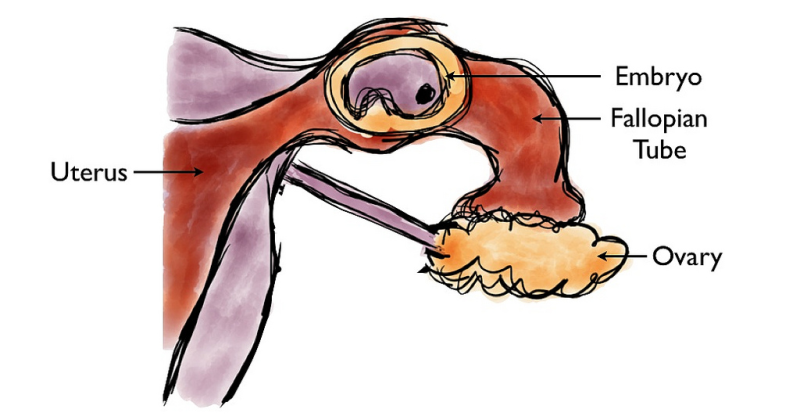
If a fertilized egg implants elsewhere, it’s an ectopic pregnancy.
Ectopic pregnancies commonly form in the fallopian tubes and can also attach to the abdominal cavity or cervix.
A fertilized egg can’t grow properly unless it implants in the inner lining of the uterus. In other words, ectopic pregnancies are not viable, and will not result in a live birth.
Ectopic Pregnancy HCG Levels
Human Chorionic Gonadotropin (hCG) is known as the pregnancy hormone.
It’s produced by the placenta as soon as a fertilized egg implants. It’s produced no matter where a fertilized egg implants.
Home pregnancy tests (HPTs) estimate the amount of hCG in your urine, and use a cut-off amount to determine if you’re pregnant or not.
Home pregnancy tests will show “pregnant” no matter where the fertilized egg implants, if you have enough hcg (pregnancy hormone) in your system.
HPTs are becoming more and more sensitive to allow testing earlier and earlier.
This also means HPTs are more likely to detect hCG from ectopic pregnancies.
Signs of an Ectopic Pregnancy
Ectopic pregnancies occur at a rate of 1–2% of pregnancies for white women in the United States. The rates are higher for non-white women (in the US), averaging 3%.
Usually (over 85% of the time), ectopic pregnancies don’t occur in a first pregnancy, although anything can happen.
Some things increase your risk of ectopic pregnancy:
- Mom is advanced maternal age - 35 years old or older.
- Previous pelvic or abdominal surgery.
- Previous inflammation or scarring of the fallopian tubes.
- History of endometriosis.
- Previous multiple abortions.
- Previous history of PID (pelvic inflammatory disease).
- Conception that occurred despite IUD (intrauterine device) or tubal ligation.
- Genetic abnormalities or birth defects of the reproductive system.
- Conception aided by reproductive technology, such as fertility drugs or procedures
- Smoking.
- Previous history of ectopic pregnancy.
- History of STD (sexually transmitted disease), such as gonorrhea or chlamydia.
Symptoms of ectopic pregnancy can appear early, but vary from woman to woman.
- Some women have no symptoms at all until an ectopic pregnancy ruptures and they experience an emergency situation.
- Just like a typical pregnancy, you may miss your period or have tender breasts, fatigue or nausea.
- As we explained earlier, if you take a home pregnancy test, it may be positive.
- You might experience light spotting or a heavier flow that is not menstrual flow. You might have tenderness or pain in your abdomen or side.
- It’s important to take any painful symptoms seriously, as ectopic pregnancies can rupture and cause an emergency situation for the mother.
What Does an Ectopic Pregnancy Feel Like?
If you experience any of these symptoms, call your doctor or 911, or go to an emergency room:
- Severe abdominal or shoulder pain.
Many women with ectopic pregnancy experience sharp waves of pain in the abdomen, shoulder, pelvis or neck. You may find it worsens with activity or while going to the bathroom.
- Spotting or bleeding after a positive home pregnancy test. The blood may look dark brown or red. It may be light or heavy.
If your fallopian tube ruptured with the ectopic pregnancy, you may experience signs of shock: fast racing pulse, dizziness, fainting, and clammy skin.
Diagnosis of Ectopic Pregnancy
If you or your doctor suspects an ectopic pregnancy he or she may order additional tests.
Transvaginal ultrasound is a special ultrasound used very early in pregnancy to locate a gestational sac in the uterus. Transvaginal ultrasounds use wands inserted directly into the vagina.
Don’t worry it’s less uncomfortable than a speculum, and most techs are very gentle. If the doctor finds a sac in the uterus, ectopic pregnancy can be ruled out for that gestational sac.
You may also need a quantitative blood test, which determines the level of hCG and progesterone in your blood. Both hormones are present during pregnancy, and the amount of hCG increases directly with pregnancy in the beginning.
For healthy pregnancies, the amount of hCG should consistently increase over the first few weeks. In the beginning it should double every two to three days. If your hCG is not increasing enough, or is decreasing, it might be a sign of ectopic pregnancy.
Remember, you might not have time for any of these tests if you have an emergency situation. Ectopic pregnancies cause approximately 40 maternal deaths each year in the US. It’s a very serious condition, so listen to your doctors and pursue treatment.
Treatment
Once your doctor has confirmed an ectopic pregnancy, what happens next depends on how dangerous the situation is for mom, and the location of the ectopic pregnancy.
The fertilized egg has to be removed to ensure the mother’s safety.
Methotrexate for Ectopic Pregnancy
Your doctor may decide to prescribe a medication that can keep the ectopic mass from bursting. A standard treatment medication may include methotrexate.
Methotrexate stops the growth of the ectopic mass.
It is given as an injection. Regular quantitative hCG blood tests will be required to ensure the medication worked.
When it works, it causes symptoms similar to a miscarriage: cramping, bleeding and passing of tissue.
You will not be able to become pregnancy again for a few months after taking the medication. This medication has less risks than surgery.
Surgery carries more risk than medication, in the form of risk of damage to the fallopian tubes and damage to long-term fertility. If required your doctor may perform a laparotomy (tiny incision) to remove the embryo and repair any damage to the fallopian tube.
If there is severe damage to the fallopian tube, it may need to be removed.
The earlier an ectopic pregnancy ends, the less damage to the mother’s body. Listen to your healthcare provider, and pursue treatment to ensure your long-term health and fertility.
One Story By holdingontohope XO My Ectopic Pregnancy and Emergency Surgery
After Diagnosis
Any loss of pregnancy is devastating.
It involves grieving the loss of the pregnancy and potential baby, and dealing with any outcomes from the ectopic pregnancy.
You may be frightened, scared and concerned.
You may be recovering from major surgery.
You’re probably physical and mentally exhausted and emotionally wrecked.
You may be suffering a hormonal rollercoaster, which makes you feel depressed or alone.
Understand, you are not alone.
You will get better and your body will heal.
Your heart will heal, although you will always remember your lost little one. Take the time you need to recuperate.
Talk to your significant other and explain how you feel.
Share your pain with those you love. They are there to help you carry your burdens.
They don’t really get it unless they’ve been there, but tell them how you feel and what it’s doing to you.
If you’ve been talking with your significant other, friends or family and still feeling like you can’t move on, or try to get pregnant again, you may want to talk to a specialist. If you don’t know a good therapist or counselor, ask friends or your doctor for a referral.
Its normal to be emotionally invested in our pregnancies, and losing one - no matter how early - is terribly hard on a woman.
Take heart knowing you are not alone in the struggle.
Take care of yourself and be kind to yourself as you heal.